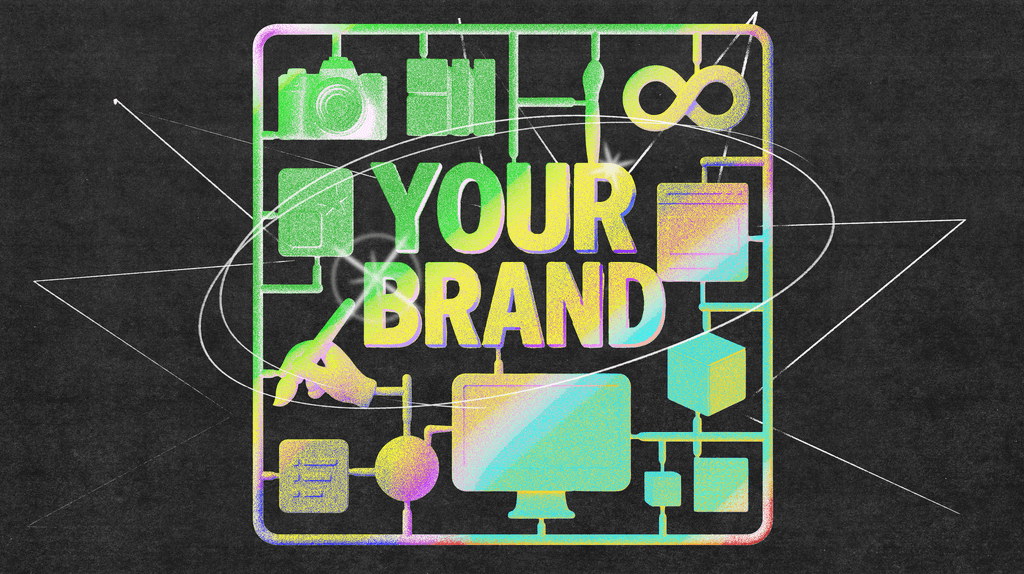
Brands are producing content at an unprecedented pace. Social ads, landing pages, campaign visuals, packaging, product UI, and even event activations all require imagery that feels both fresh and consistent.
The challenge? Each format often demands a different visual style. A landing page might use 3D renders, social content might use illustration, and packaging might need mixed-media collage. Without a system, these efforts can splinter into chaos.
An imagery toolkit solves this by creating a modular library of visual assets: illustrations, 3D renders, photography treatments, textures, and motion stills, all designed to work together. It's a universe of imagery that teams can remix and expand over time.
Consistency Without Sameness
An imagery toolkit ensures that whether you're using photography, illustration, or 3D, it all feels like it belongs to the same brand. Instead of every asset looking like it came from a different vendor, you get one cohesive visual language.
Materials that don’t conform to brand guidelines. Only 10% say it never happens.
Efficiency and Speed
Building visuals from scratch for every campaign is slow. With a toolkit, you can pull from an established library of assets and adapt them. Want a new ad? Swap in different characters or textures. Need a seasonal update? Re-color or layer in new props. This reduces turnaround time from weeks to days, a huge advantage when responding to trends or launching products fast.
Keeping a brand consistent doesn’t slow a team down.

Cross-Channel Flexibility
An imagery toolkit is designed to scale across every channel. Web and product: 3D renders, icon systems, UI illustrations. Social: quick-turn mixed-media posts, GIF loops, character templates. Campaigns: hero illustrations, photography with branded overlays. Packaging and print: simplified versions of toolkit visuals adapted for physical formats. Instead of reinventing assets for each medium, the toolkit gives you a plug-and-play system that adapts across platforms.
Empowering Teams
With toolkits, teams outside of design, like marketing or sales, can produce visuals themselves using templates and pre-approved imagery. That frees creative teams to focus on big-picture storytelling instead of production bottlenecks. It's not about removing creativity. It's about giving everyone a sandbox that's already aligned with the brand.
Long-Term Creative Equity
Campaigns fade, but toolkits grow in value. Each new project adds to the visual library: more props, textures, poses, and treatments. Over time, you build a visual universe unique to your brand, one that no competitor can replicate. It becomes an asset in its own right, compounding in value as your company scales.
Sources
- Demand Metric for Lucidpress, Oct 2016The impact of brand consistency
- Ehrenberg-Bass InstituteReport points to what makes brands distinctive